


Buyer Persona and Customer Journey Examples
Buyer research, audience definition, and journey-stage planning teams can use across web, sales, campaigns, and GTM work.
We help teams understand who the buyers are, what they need, and how they decide. The work covers buyer roles, needs, objections, decision criteria, content priorities, and journey-stage requirements that support positioning, website structure, sales materials, GTM planning, campaigns, and outreach.
When clients need this
Clients usually need this when the product or service is clear internally, but the buyer logic is still too broad. The team may be writing to “the market” instead of specific buyers, or building website, sales, and campaign materials before they understand how different audiences actually research, compare, and decide.
What I usually own
Buyer and audience definition
ICP and segment priorities
Buyer persona development
Buyer needs, objections, and decision criteria
Customer journey mapping
Content and channel needs by stage
Messaging implications for web, sales, and outreach
What clients get
Clearer buyer priorities
Sharper audience language
More useful website and content direction
Better sales and outreach inputs
Clearer journey-stage content needs
A stronger link between positioning and GTM execution
RESULTS FROM RECENT CLIENTS
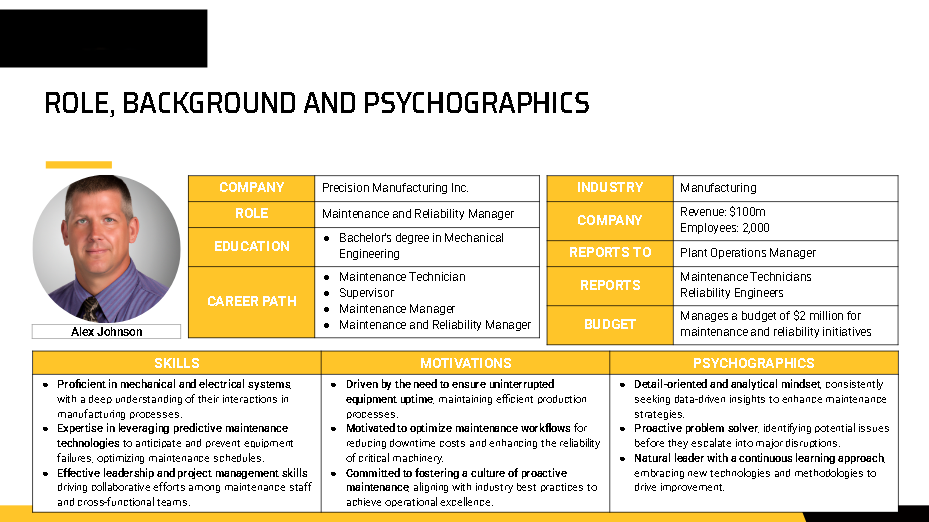
An industrial predictive maintenance company needed clearer buyer insight for maintenance, reliability, engineering, operations, and manufacturing audiences.
Developed buyer personas covering role, goals, priorities, performance metrics, daily tasks, purchase process, decision team, roadblocks, and preferred content. Translated technical industrial buying behavior into practical guidance for messaging, case studies, sales materials, and journey-stage content.
The result was a clearer view of how industrial buyers evaluate predictive maintenance and what proof they need before trusting a new solution.
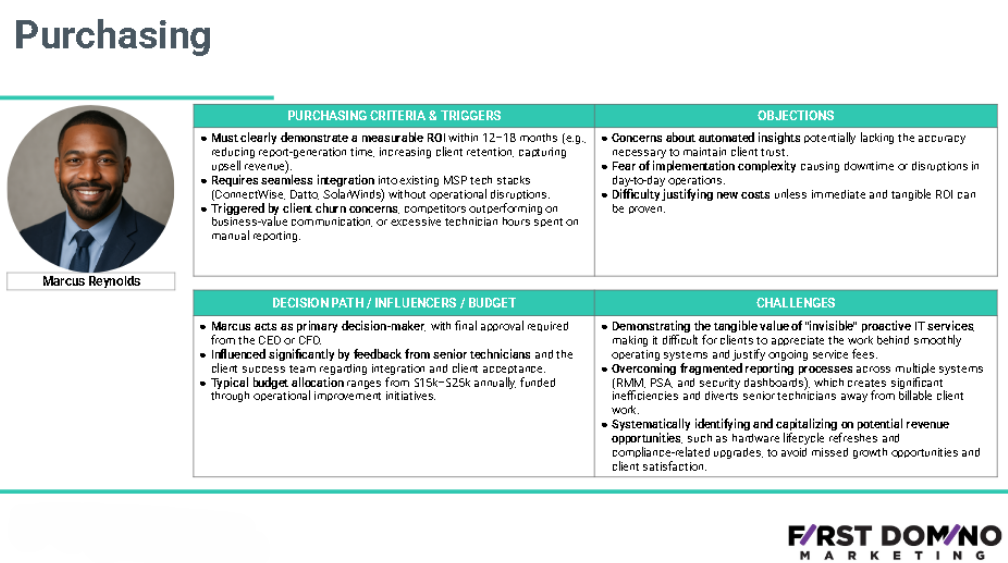
An MSP-focused compliance platform needed buyer clarity before launching into a crowded market.
Developed personas for MSP operations, compliance/security, and client success buyers, including goals, priorities, purchasing triggers, objections, decision paths, budgets, and content preferences. Clarified how different stakeholders evaluate ROI, audit readiness, reporting accuracy, integration risk, client communication, and expansion revenue.
The result was a more useful buyer foundation for positioning, launch messaging, sales assets, pilot design, and persona-specific outreach.
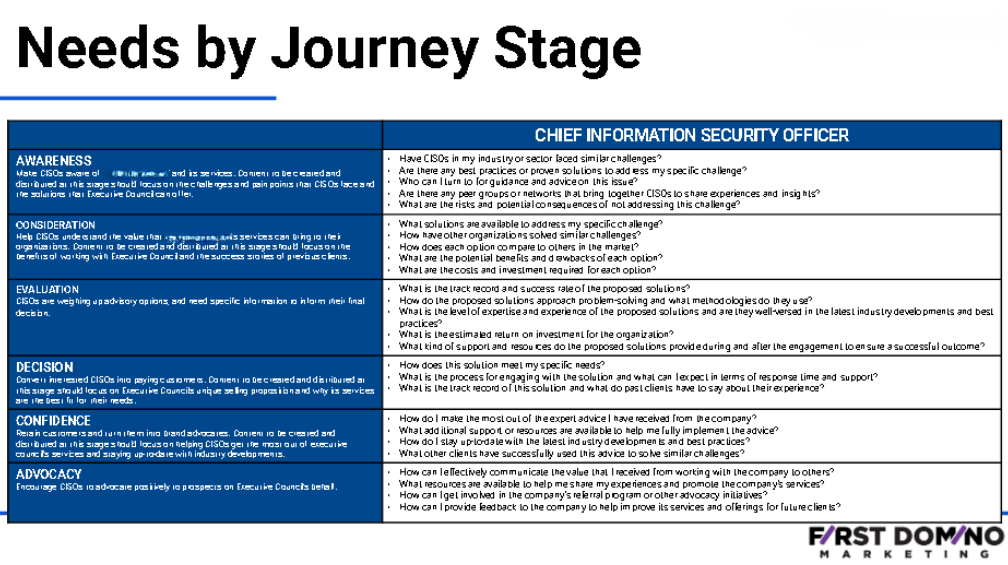
A peer-to-peer advisory business serving CISOs needed a clearer view of how senior security buyers evaluate outside expertise.
Developed a detailed CISO persona covering role, priorities, goals, purchase process, decision team, roadblocks, content sources, and expectations of third-party experts. Mapped the buyer journey from awareness through advocacy, including the questions CISOs ask at each stage and the content needed to support trust and decision-making.
The result was a clearer buyer model for a senior security audience and a stronger foundation for messaging, content, website structure, and launch planning.
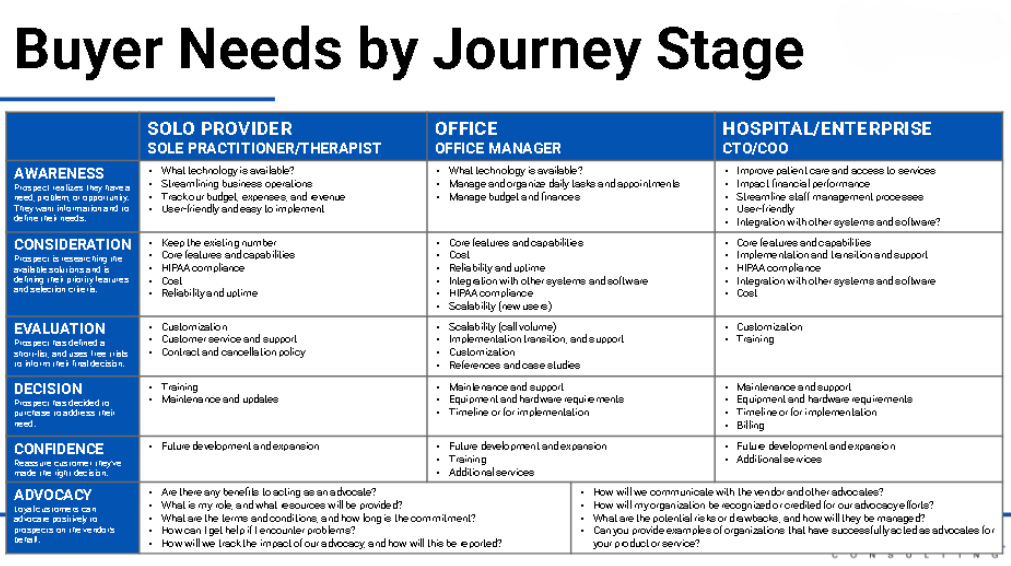
A healthcare communications SaaS company needed to understand how different practice types evaluate phone, text, fax, and HIPAA-related communications tools.
Mapped buyer needs across solo providers, office managers, and hospital/enterprise leaders. Clarified how each audience thinks about cost, reliability, HIPAA compliance, scalability, implementation, training, support, and confidence after purchase.
The result was a more practical journey model for website messaging, content planning, channel priorities, and growth beyond solo providers into larger practices.
HOW TO START
Specific project: A defined buyer, ICP, or customer journey problem with a clear deliverable and fixed timeline.
Short sprint: Fast work on a single buyer, audience, or journey-stage problem, usually two to four weeks.
Ongoing support: Regular strategic support to keep buyer insight aligned with positioning, website, content, campaigns, and sales activity.
Know the problem? I can usually point you to the right starting place quickly.
Still sorting it out? That’s fine. Figuring out where to begin is part of the work.