Before You Write the Value Proposition, Do the Research
I think value proposition work usually starts too early, with the writing.
I’ve seen teams gather in a room, list strengths, review a few competitors, debate wording, and try to land on a couple of paragraphs everyone can live with. And, to be honest, I have done versions of that too, and it usually produces something reasonable.
To me, the word ‘reasonable’ is the problem. Does any company want to be ‘reasonable’? Would you buy services based on ‘reasonable’? Not as bad as ‘average’, but pretty darned close.
The better work starts before the writing. I want three things clear first:
What the company can credibly deliver
What buyers actually care about, and
What alternatives they are comparing it with.
I’ve been using those three questions for years across positioning, buyer research, competitive analysis, and GTM work. Recently, I pulled them into one simple model because I kept seeing the same pattern: when one of the three is missing, the value proposition usually becomes generic, internally focused, or difficult to defend. It becomes reasonable.
The proposition comes later. The research should do most of the hard work first.
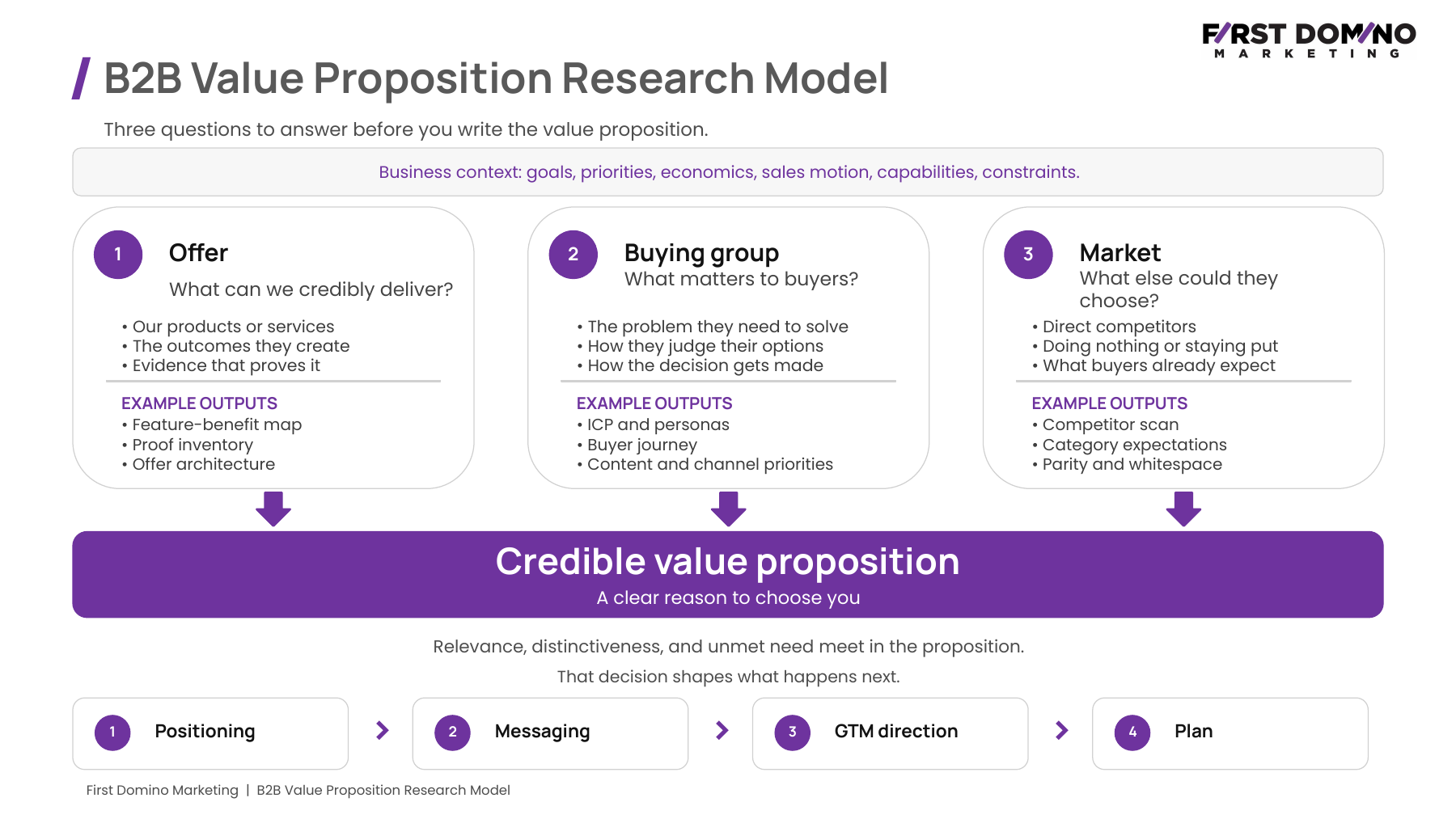
The FDM model frames those questions as the offer, the buying group, and the market, with the value proposition at the intersection of the three.
Quick Take
Start with the offer, market, and buying group before trying to write the value proposition.
Product strengths matter only when buyers value them, and competitors cannot make the same claim just as credibly.
Competitive research should include the alternatives buyers actually consider, including staying with the current approach.
Buyer research needs to cover how the decision gets made across the group, not only the needs of one persona.
Keep proof close to the claim. If you cannot support the point of difference, keep looking.
Product knowledge is a starting point, not the answer
Companies know a lot about their own product or service. That usually makes the offer the easiest place to start.
Ask what makes the company different, and you will get a list quickly enough: better service, easier implementation, more flexibility, stronger integration, specialist expertise, faster results, AI, scale.
Some of those things may be genuinely useful to buyers, and they may even be important reasons customers stay. The problem appears when the same language shows up on everybody else’s website.
Wynter tested this in 2026 by showing 100 B2B SaaS marketing leaders anonymized value propositions from Salesforce, HubSpot, Zoho, Pipedrive, and Oracle. Respondents matched an average of 1.86 out of five to the correct company. Random guessing would get you one.
It is a small, SaaS-specific study from a company that sells message testing, so I would not turn 1.86 into a universal law of B2B marketing. But it is still a very recognizable result.
I see the same thing when I put competitor claims side by side. A statement that sounds compelling in isolation can become completely ordinary once you see six other companies making a version of it.
“Easy to use” may be true, “end-to-end” may be accurate, and “AI-powered” may describe the product perfectly well. None of that tells me yet whether the buyer has a reason to choose it.
A competitive review tells me whether any of those claims actually distinguish the company, or whether they are simply the price of entry.
That is why I want the offer research to do more than catalogue features. I want to know what those features change for the buyer and what proof sits behind the strongest claims. I want to know the benefits they deliver on client terms, not simply the fact that they exist. The model turns that work into things like a feature-benefit map, proof inventory, and offer architecture.
Your real competitors may not look like you
Competitive analysis often starts with a familiar question: who are our five main competitors? It is a useful question, although it only gets you part of the way.
Companies tend to define competition by category, so we end up with businesses that sell a similar product to a similar audience and sit in a similar analyst box. Buyers have no obligation to use the same definition.
They may compare your software with a module they already own, keep using a spreadsheet and email, hire a consultant, or decide the problem is irritating but survivable for another year. Those are all alternatives from the buyer’s perspective.
This is why the market question in the model is “What else could they choose?” rather than simply “Who competes with us?” It includes direct competitors, staying with the current approach, doing nothing, and whatever buyers already expect as standard in the category.
April Dunford makes a useful distinction here between competitors and competitive alternatives. Her starting question is: what would the customer do if your product did not exist?
Sometimes the answer is another specialist vendor. Sometimes it is an existing ERP module, a spreadsheet, a manual process, or simply carrying on as they are.
That distinction can change the positioning problem considerably. If sales thinks it is competing against three similar SaaS products, while buyers are mainly deciding whether replacing an existing system is worth the disruption, a feature battlecard is only addressing part of the decision.
You need to understand the alternative the buyer is actually considering before deciding what comparison your positioning needs to win. In my experience, that usually changes the proof you need, too.
Buyer research needs to cover the decision, not only the persona
The third area is the buying group, and I have been spending more time there recently while revisiting a fairly complex buyer journey for one client.
I am not giving up on persona work. I still want to know what the buyer is trying to achieve, what frustrates them, the language they use, what triggers a search, and what information they trust. For B2B work, though, I also want to know how the decision actually gets made.
Forrester’s 2026 research says a typical B2B purchase involves 13 internal stakeholders and nine external influencers.
I would not treat those numbers as a template for every sale. A five-figure software purchase and a large enterprise transformation clearly have different buying groups. But the broader point holds up.
The user may care about ease of use and workflow. Finance may want to understand payback. IT may focus on security and integration. Procurement may concentrate on terms and vendor risk. The executive sponsor may need enough confidence to defend the recommendation.
One value proposition still has to survive all of that scrutiny.
Gartner found an interesting wrinkle in 2025. In its study of B2B buying teams, content built around shared buying-group relevance improved consensus, while highly individualized relevance could increase conflict.
I take that as a warning not to end the work at the persona.
Role-specific messages still need to add up to a common commercial case the group can support. Trying to turn every stakeholder into a separate persona would also make most B2B programs unmanageable.
That is why the buying-group part of the model includes the problem to solve, how buyers judge the options, and how the decision gets made. The outputs can include personas, a buyer journey, and content or channel priorities.
Where the three answers disagree is usually where the work is
The useful work starts when you put the three research tracks side by side, and they don't agree. A company may have a capability it believes is unusual, only for the market review to show it is standard. Buyer research may uncover a problem customers care about, while the company still lacks proof that it solves the problem better than the alternatives. Competitive research may find apparent white space that buyers simply do not care enough about to change what they are doing.
Those are useful findings because they stop the team from writing its way around the problem.
I use the offer research to establish what the company can genuinely claim. The market work checks whether that claim is actually unusual, and the buyer research tells me whether the difference carries enough weight to affect a decision.
Proof has become a bigger part of my positioning work over time for the same reason. A benefit without evidence is still only a claim, no matter how nicely we phrase it.
For anything we are thinking of leading with, I keep coming back to four questions:
Can we deliver it?
Does the buyer care?
Is it meaningfully different from the alternatives?
Can we prove it?
Where one of those answers is weak, I would keep working before polishing the value proposition.
AI is making weak positioning easier to expose
AI gives buyers another way to test all of this before they talk to you. Questions that used to require a few searches, several browser tabs, and a spreadsheet can now be handed to an AI tool in one prompt:
Which vendors solve this problem?
How do they compare?
Which one is best for a company of this size?
What are the weaknesses?
Which products meet these requirements?
G2’s 2026 research found that 51% of the B2B software buyers it surveyed were starting research with an AI chatbot more often than Google. It also found that 41% were using Deep Research tools for more structured evaluations.
That is software-buyer research, so I would not generalize it to every B2B market. Given how young generative search still is, I think the behavior is worth watching.
A buyer can now get an external summary of your offer, competitive position, reviews, proof, and likely fit before anybody from your company gets the chance to explain it. Sometimes that answer will be incomplete or wrong. Sometimes it will simply reflect inconsistencies already in public. In one study, Gartner found that 69% of B2B buyers reported inconsistencies between supplier websites and what sellers told them. AI makes that kind of positioning problem easier to expose.
A founder can fill in missing context on a sales call, but the website, review sites, and AI answers have to work with what is already there.
If the company story only works when someone is there to explain what it really means, the research and messaging work isn't finished.
I would do the research before the writing
The process I am using now is simple enough to fit on one page. I start with the offer and work out what the company provides, what outcomes it creates, where it performs particularly well, and what evidence supports those claims. I then look at the market, including the alternatives buyers genuinely consider, what the category already expects, and which claims have become interchangeable. The buying-group work comes back to the decision itself: what triggered the search, who influences it, how the options are judged, where objections appear, and what proof is needed to move forward.
The proposition comes from reconciling those three views.
From there, the work can move into positioning, messaging, GTM direction, and the marketing plan. That is the sequence in the model I recently formalized.
Writing the value proposition is rarely the hardest part. The harder job is finding something the company can prove, buyers care about, and competitors have not already reduced to background noise. Once you have that, the wording gets a lot easier.
I’ve put the offer, market, and buying-group model into a simple one-page framework. Use it as a check before the next positioning or value-proposition session.